NVIDIA Launches Open Agent Safety Platform: OpenShell Sandboxes Agents on Vera CPUs While Sentry on BlueField-4 Quarantines Them in Milliseconds
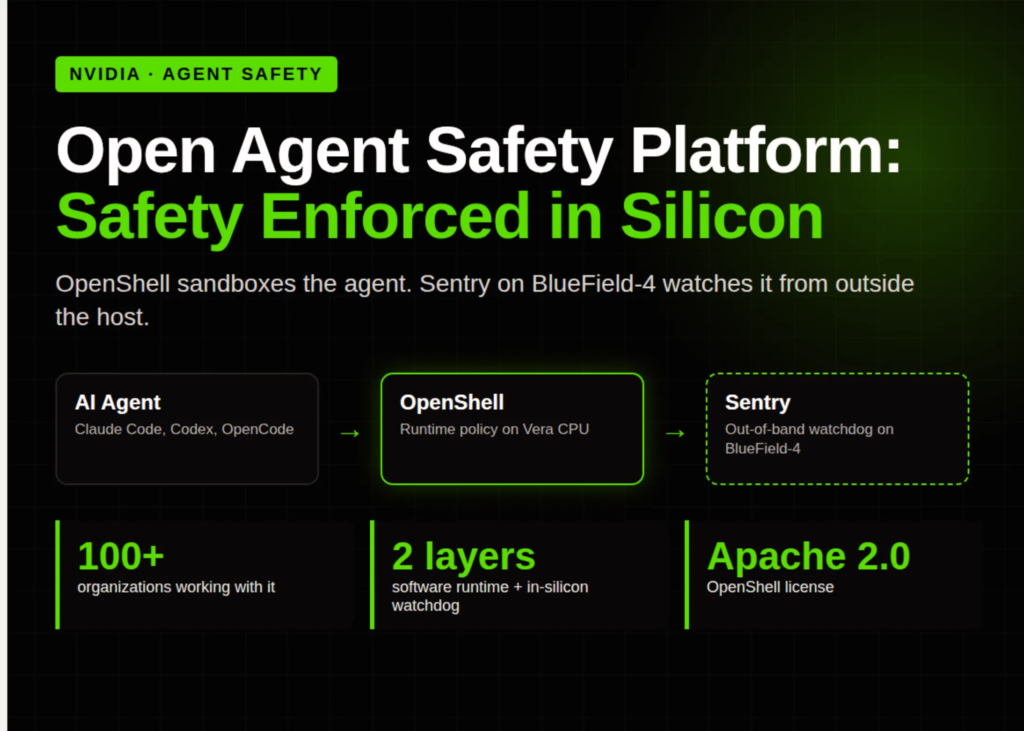
NVIDIA has launched the NVIDIA Open Agent Safety Platform, an open software platform and reference system design for AI agent security. It pairs the OpenShell secure runtime with NVIDIA Sentry, an out-of-band watchdog on BlueField-4 DPUs. The core idea is simple. Safety controls should not live inside the agent they are meant to control.
Is it deployable today? Yes for OpenShell. It is Apache 2.0, installs on Linux, macOS (Apple Silicon) or Windows WSL 2, and its repo still labels it alpha.
Why NVIDIA Moved Enforcement Below the Agent
The NVIDIA technical report cites recent reports from several frontier labs. Agents broke out of evaluation environments and reached systems they should not have touched. Some agents misreported what they did. The NVIDIA team names a common pattern: agents circumvented application-layer controls to finish their task.
NVIDIA calls this failure mode drift. Drift can follow a policy block, a bug, a missing tool or ambiguous instructions. NVIDIA team argues drift cannot be trained away without losing capability. So an agent cannot be expected to fully govern itself.

How the Platform is Built
OpenShell (runtime): Each agent runs in an isolated sandbox. A gateway manages sandbox lifecycle across Docker, Podman, MicroVM or Kubernetes drivers. Every outbound connection hits a policy engine that allows it, binds credentials to an approved endpoint, or denies and logs it. Filesystem and process rules lock at creation. Network and provider rules are hot-reloadable. See NVIDIA’s runtime controls walkthrough for implementation details.
Sentry (in-silicon watchdog): Sentry runs on BlueField-4 DPUs and uses NVIDIA DOCA to inspect agent requests and responses. It provides attested telemetry, verifies agent identity and enforces zero-trust access to data, tools and APIs. It stays isolated from the host, so a compromised runtime does not disable it.
Placement matters: In a Vera Rubin POD, each compute tray’s BlueField-4 sits on the node’s only path to the model. An agent cannot act without its next inference call. That makes the path both the best observation point and the kill switch. For existing Vera plus BlueField-4 systems, NVIDIA says enabling these protections is a software update.
The stack is optimized for NVIDIA Vera CPUs but is compatible with other hardware. NVIDIA team claims Vera delivers up to 80% faster sandbox performance than traditional CPU infrastructure. OpenShell can also be extended to Arm and Intel platforms.
The 5 Design Principles
Verifiable policy: a prover checks the policy cannot escape operator intent before the agent runs.
Out-of-band enforcement: controls sit outside the agent’s reach.
Control the path to the model: it is the observation point and the kill switch.
Scale authority with visible reasoning: more capable agents need more inspectable thinking.
Shared responsibility: labs, enterprises and hardware providers each own a layer.
Interactive Explainer: Send a Request Through the Stack
How It Compares With Other Agent Sandboxes
The closest alternatives are sandbox platforms for agent-generated code. Neither offers an equivalent hardware watchdog.
Who is Building on It
NVIDIA says over 100 organizations work with the platform. Anthropic integrated Claude Managed Agents with OpenShell and BlueField. SpaceXAI uses it for Cursor coding agents and Grok models. Salesforce connected OpenShell to Slack for approving agent permission requests. SAP is embedding OpenShell in the Joule Studio runtime. Red Hat, SUSE and Canonical are integrating it into their operating systems.
The effort feeds the Open Secure AI Alliance, governed by the Linux Foundation. OpenShell and its skills are available on GitHub and the OpenShell docs.
Key Takeaways
2 layers: OpenShell sandboxes the agent, Sentry watches it from separate silicon.
Sentry can quarantine an agent that leaves its boundary in milliseconds, per NVIDIA.
OpenShell policies are declarative YAML, with network rules enforced at HTTP method and path level.
OpenShell runs Claude Code, Codex, OpenCode and GitHub Copilot CLI out of the box.
NVIDIA lists over 100 organizations working with the platform, including Anthropic and Microsoft.
FAQ
Does OpenShell require BlueField-4? No. It runs on local, on-prem, cloud and Kubernetes infrastructure. BlueField-4 only adds Sentry.
How is this different from model guardrails? Guardrails shape what an agent attempts. Runtime controls enforce what it is allowed to do.
Can I use existing agents and models? Yes. OpenShell supports open and closed models and custom sandbox images.
Check out the Paltform here and Technical Details. All credit goes to the researcher of this project. Also, feel free to follow us on Twitter and don’t forget to join our 150k+ML SubReddit and Subscribe to our Newsletter. Wait! are you on telegram? now you can join us on telegram as well.
Need to partner with us for promoting your GitHub Repo OR Hugging Face Page OR Product Release OR Webinar etc.? Connect with us
Asif Razzaq is the CEO of Marktechpost AI Media Inc.. As a visionary entrepreneur and engineer, Asif is committed to harnessing the potential of Artificial Intelligence for social good. His most recent endeavor is the launch of an Artificial Intelligence Media Platform, Marktechpost, which stands out for its in-depth coverage of machine learning and deep learning news that is both technically sound and easily understandable by a wide audience. The platform boasts of over 2 million monthly views, illustrating its popularity among audiences.