XRP struggles below key resistance amid geopolitical tensions
Key takeaways
Risk sentiment across financial markets remained fragile following conflicting statements from US and Iranian officials.
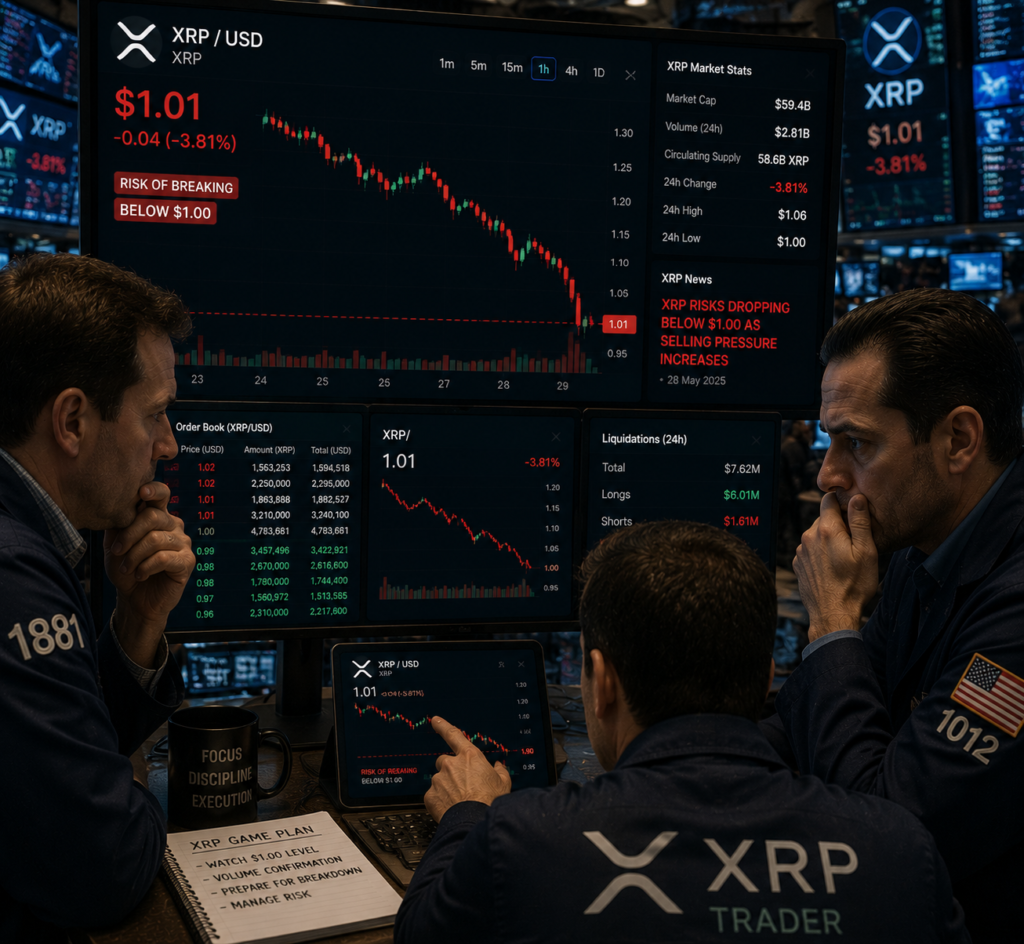
XRP risks dropping below $1.0 if the bearish trend persists.
Ripple’s XRP remained under pressure on Wednesday, trading below $1.10 and maintaining a broader bearish outlook.

The remittance-focused cryptocurrency failed to extend an early-week recovery attempt as investors reacted to renewed geopolitical uncertainty surrounding negotiations between the United States and Iran.
Mixed US-Iran signals fuel market uncertainty
Risk sentiment across financial markets remained fragile following conflicting statements from US and Iranian officials after the first round of peace negotiations held in Switzerland.
US Vice President JD Vance said late Monday that Iran had agreed to allow inspectors from the International Atomic Energy Agency (IAEA) back into the country. However, Iranian authorities disputed the claim, insisting that Tehran had made no additional commitments during the discussions.
Iran’s chief negotiator, Mohammad Bagher Ghalibaf, stated that the United States had agreed to release approximately $12 billion in frozen Iranian assets.
Meanwhile, Donald Trump warned reporters that Washington would take further action if Iran failed to comply with the terms of any agreement.
The conflicting messages have contributed to risk-off sentiment across cryptocurrency markets, limiting demand for digital assets and reinforcing bearish pressure on XRP.
Investor sentiment across the cryptocurrency market remains weak despite a slight improvement in confidence levels.
The Crypto Fear & Greed Index registered a reading of 23 on Monday, remaining firmly in “Extreme Fear” territory. While the index improved marginally from 20 recorded a day earlier, market participants continue to adopt a cautious stance amid macroeconomic and geopolitical uncertainties.
The subdued sentiment suggests that traders remain reluctant to aggressively accumulate risk assets, increasing the likelihood that short-term rallies could face selling pressure.
XRP price forecast: Bears continue to control the trend
From a technical perspective, XRP continues to exhibit a bearish structure on the daily timeframe.
The token is trading well below its key Exponential Moving Averages (EMAs), including the 50-day EMA at $1.25, the 100-day EMA at $1.35, and the 200-day EMA at $1.56.
XRP also remains below the middle Bollinger Band near $1.15, reinforcing the current downward bias.
Momentum indicators further support the cautious outlook. The Relative Strength Index (RSI) sits around 38, signaling weak bearish momentum without yet reaching oversold conditions.
Meanwhile, the Moving Average Convergence Divergence (MACD) histogram remains slightly positive around the zero line, indicating tentative stabilization rather than a decisive trend reversal.
For XRP to regain bullish momentum, buyers must overcome several important resistance zones.
The first hurdle lies at the Bollinger Band midpoint near $1.15, followed by resistance at the upper Bollinger Band around $1.22.
Beyond that, the 50-day EMA at $1.25 and a descending trendline near $1.28 create a significant supply zone. Additional resistance levels are located at the 100-day EMA around $1.35 and the 200-day EMA near $1.56.
A successful break above these barriers would be required to shift the broader market structure back toward a bullish outlook.
On the downside, XRP’s immediate support is located near the lower Bollinger Band at $1.07.
A decisive breakdown below this level could accelerate selling pressure and expose the token to a retest of the recent support zone around $1.05.

Should bearish momentum intensify further, traders may look toward the psychologically important $1.00 level as the next major area of demand.
Until buyers reclaim key resistance levels, XRP remains susceptible to additional downside risk in the near term.