D&B's database of 642 million businesses was built for humans, not AI agents. So they rebuilt it.
Dun & Bradstreet has spent over 180 years building a comprehensive commercial database. Its Commercial Graph, covering 642 million businesses and their relationships, corporate hierarchies and risk profiles, was designed for people. Credit analysts, risk managers and sales professionals who could wait for query results and work through ambiguous entity matches. AI agents cannot do any of those things.
When D&B's customers started pushing agents into credit, procurement and supply chain workflows, the Commercial Graph that had reliably served nearly 200,000 customers globally became a problem. The systems built to serve human analysts were the wrong architecture for machines. So D&B rebuilt.
"We need to think about agents as our new consumer category, evolving from our standard credit analysts or sales and marketing professionals, et cetera, to also now catering to these customers' agents," Gary Kotovets, Chief Data and Analytics Officer at Dun & Bradstreet, told VentureBeat.
What broke when agents started querying
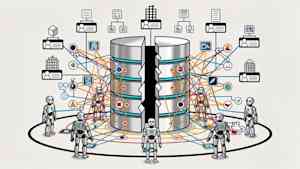
The Commercial Graph was not a single database. It was a collection of separate systems built for different use cases and different markets, held together by custom integrations. Human analysts navigated that fragmentation through SQL queries or pre-built interfaces. Agents could not.

The scale of the underlying data compounded the problem. The database had nearly doubled in five years, expanding from more than 300 million to more than 642 million business records, with 11,000 fields per record, according to D&B. The firm now runs approximately 100 billion data quality checks per month as records move through its systems. Querying that at the sub-second latency agents require, against a fragmented architecture, was not workable.
The relationships the graph tracked were also the wrong kind. Legacy systems recorded static connections between entities. A CEO was linked to a company. That was the line. Agents working on credit assessments or third-party risk need dynamic relationships: when that CEO leaves for a new company, which organization does their track record follow? When a subsidiary changes ownership, how does that propagate across a corporate hierarchy? Those questions required custom analyst work before. Agents cannot wait for custom analyst work.
The broader problem is not unique to D&B. Kotovets said he has spoken with hundreds of CDOs and CIOs over the past six months and consistently heard the same constraint: they could not build what they wanted in AI because their data foundations were not standardized, normalized or agent-queryable. D&B had that foundation, built over decades to serve human analysts. It still had to rebuild for agents.
What they actually built
The rebuild started with consolidation. D&B migrated its fragmented databases to cloud infrastructure, redesigned the underlying schema and built a data fabric layer that normalizes records across markets while preserving regional compliance requirements. The result is a unified knowledge graph that tracks billions of relationships across 642 million companies, continuously updated and enriched by AI-driven data processing.
On top of that graph, D&B built a structured access layer for agents. Raw SQL access at agent query volumes and latency requirements was not the answer. Instead, D&B created a set of tools and skills available through MCP that package data with context and route agents to the right records for specific queries. A match and entity resolution engine sits behind every query, confirming that when an agent asks about a company, the answer resolves to a verified, specific entity rather than a name match.
D&B solved agent identity from both directions
Rebuilding the graph and adding MCP access solved the data retrieval problem. It did not solve the identity problem. Agents are not humans, and the authentication model built for human users did not extend to machines.
D&B built a new registration model for agents. They must map to a verified IP address and register an individual access key, treated as an authenticated identity in the same pipeline as a human user.
"We actually have a concept of Know Your Agent, similar to know your customer, that does those additional verifications," Kotovets said.
That handles the inbound problem: knowing which company an agent belongs to and what data it is entitled to query. But D&B also built for the outbound problem: what happens when a customer's own multi-agent workflow loses track of which company it is analyzing.
In a workflow that chains a credit check agent, a KYC agent and a third-party risk agent, each queries D&B at a different step. Without a mechanism to confirm they are all referencing the same entity, a workflow can complete while operating on divergent records.
"They have to come back to our verification agent to ensure that they're still talking to each other about the same entity," Kotovets said. "It's almost like a digital handshake, in a sense."
D&B's business verification agent can be embedded into any workflow as a persistent reference point and is available on Google's A2A protocol regardless of which orchestration tool a customer uses.
Four things enterprises must get right before deploying AI agents
The rebuild exposed requirements that go beyond D&B's own stack.
Data foundations come before agent infrastructure. The CDOs and CIOs Kotovets spoke with over the past six months consistently hit the same wall: they cannot build what they want in AI until their data is clean, normalized and consolidated. D&B had that foundation already. Most enterprises do not, and they will feel it.
Design for dynamic relationships, not static ones. Enterprise data systems typically record point-in-time connections: a person belongs to a company, an asset belongs to a subsidiary. Agents working on credit, risk or supply chain decisions need to reason across relationships that shift over time. If the underlying data only captures the static line, the agent will too.
Build entity consistency checks into multi-agent workflows. When multiple agents touch the same entity at different steps, there is no guarantee they are all referencing the same record by the time the workflow completes. That gap needs to be engineered for explicitly. Entity verification is a workflow design requirement, not an optional guardrail.
Embed lineage from the start, not as an afterthought. Every agent-produced answer should carry a traceable path back to its source. In credit, risk and supply chain decisions, the cost of an error is concrete. Lineage needs to be built in before scaling, not added after problems surface.
"You could always click and see where it came from, and validate it all the way back to the original source," Kotovets said. "That's been the key for us in unlocking a lot of other capabilities, because we have that level of certainty in the things that we've done."